
“Compound interest is the eighth wonder of the world. He who understands it, earns it; he who doesn’t, pays it”
—Albert Einstein
Compounding is one of the most powerful forces in long-term investing. Most people associate it with reinvesting interest or dividends, but within the supported-living property sector there is another form of compounding that can be important to investors: the annual growth of rental income.
The majority of the properties available through Housemartin are leased to specialist housing partners under leases containing regular inflation-linked rent reviews. Over a single year, the difference can appear relatively modest, but over five, ten, fifteen or twenty years the cumulative effect can become much more significant.
Different partners, different rent-review structures
Housemartin works with a range of specialist housing partners and registered providers, and the precise rent-review mechanism can vary between them. Looking across lease structures currently used within the Housemartin portfolio gives a useful indication of the different approaches that investors may encounter.
|
Housing partner |
Typical rent-review structure evidenced |
What this means |
|---|---|---|
|
Typically CPI-linked |
Rent is generally reviewed annually by reference to CPI, although the exact mechanism can vary between leases |
|
|
CPI-linked, capped |
The leases reviewed provide for annual CPI increases, with an example lease capped at 6% per annum |
|
|
Rent Standard-linked |
Increases can be requested up to the inflationary increase permitted under the applicable Rent Standard, subject to the lease terms and local-authority approval |
|
|
Lease-specific |
Structures can include CPI, capped CPI, RPI or increases linked to the prevailing social-housing rent regime |
For example, an executed GLH lease reviewed by Housemartin provides for the annual rent to be recalculated by reference to changes in the Consumer Prices Index (CPI). Let’s for Life is another repeat Housemartin lease counterparty across multiple properties, and in the lease wording reviewed the rent is linked to CPI with the annual increase capped at 6%.
Halo uses a somewhat different structure, with its lease providing that any increase should not exceed the inflationary increase permitted under the Regulator of Social Housing’s Rent Standard, subject to local-authority approval. Under the current Rent Standard, that can generally mean an annual increase of up to CPI + 1%, subject to the detailed rules and the specific lease.
The key point is that inflation-linked rent reviews are a recurring feature across most Housemartin housing-partner relationships, but there is no single formula that applies across the whole portfolio. Investors therefore need to look at the lease for the individual property to understand exactly how the rent can increase, whether a cap applies, and whether any external approval or regulatory framework affects the review.
What does inflation-linked compounding actually mean?
Consider an investment generating £25,000 of annual rent. If that rent increased by an average of 3% each year, the increase would not simply be £750 every year. The first increase would take the rent to £25,750, and the following year’s increase would then be calculated against that higher amount. The same process would continue each year, which means the growth itself starts to compound.
As an example, we can look at #136 – Durris Close, Coalville, which was launched on the Housemartin Exchange back in 2021. The lease includes a clause for an annual rent increase of the lower of CPI or Regulator of Social Housing (RSH) Cap.
|
Year |
Annual Rent |
Increase from starting rent (%) |
CPI |
|---|---|---|---|
|
Starting rent (2021/22) |
£12,600 |
— |
— |
|
2022/23 |
£13,788 |
9.4 |
9.4 |
|
2023/24 |
£14,877 |
18 |
7.9 |
|
2024/25 |
£15,175 |
20 |
2 |
|
2025/26 |
£15,721 |
24.8 |
3.6 |
|
2026/27 |
£16,908 |
34.2 |
2.6 |
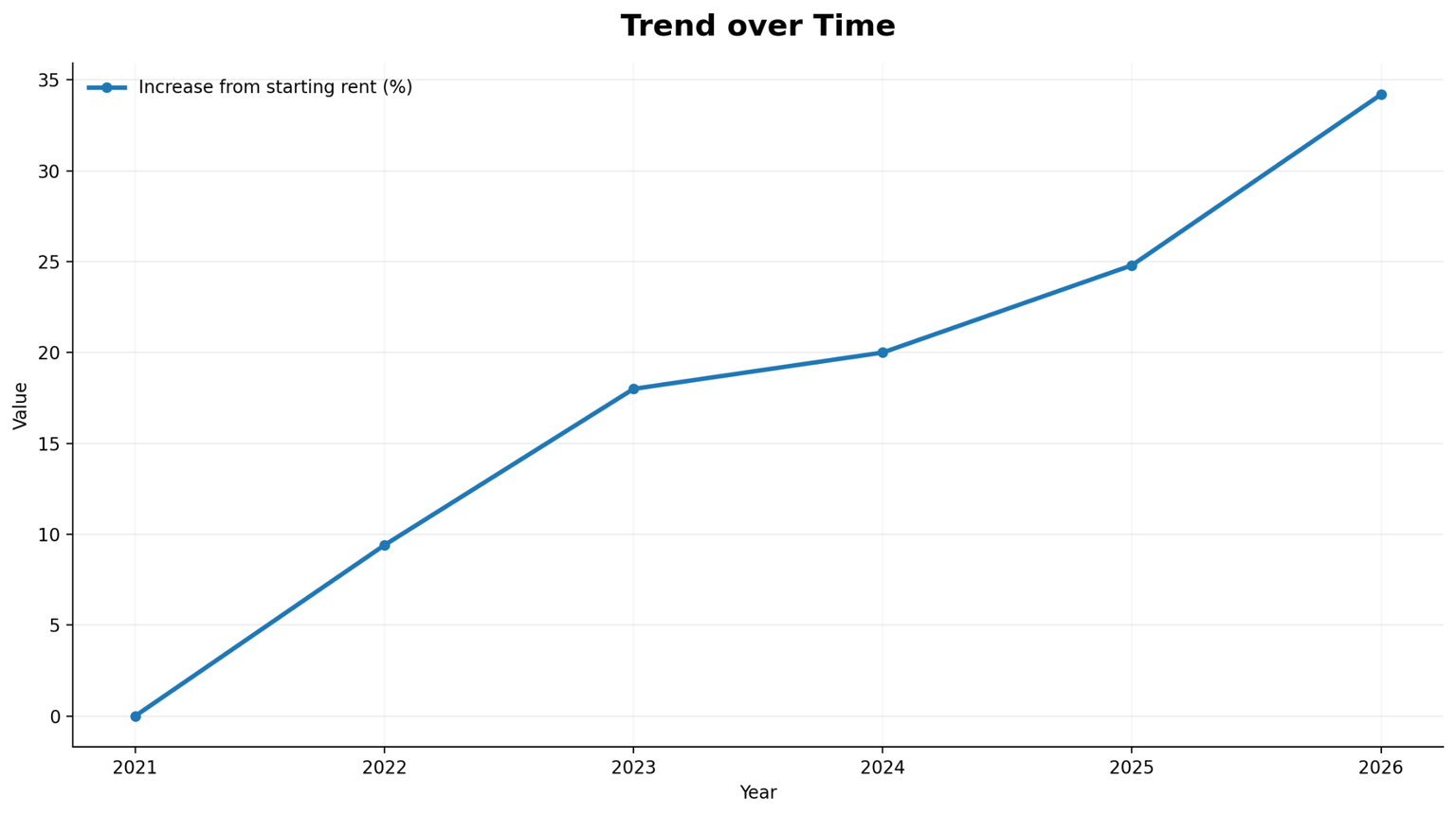
Inflation will vary, caps may apply, and individual lease terms differ. However, this example demonstrates why compounding becomes increasingly important the longer an investment is held. A relatively small annual increase can build into a much larger change in rental income over time, particularly where those increases continue year after year.
Why an extra 1% can make a big difference
An additional one percentage point in annual growth can sound relatively insignificant when viewed over a single year, but over a longer period it can have a much more meaningful effect. If £25,000 of annual rent increased by 2% each year, it would grow to approximately £37,149 after twenty years. At 3% annual growth, it would reach approximately £45,153 over the same period.
That is a difference of around £8,000 per annum by year twenty, despite the annual growth rate being only one percentage point higher. This is why a structure such as CPI + 1%, where it applies, can have a materially different long-term effect from straight CPI if it is sustained over many years. The significance comes not just from the higher annual increase, but from the fact that each increase is then applied to a progressively higher rental base.
What about leases linked to RPI?
A smaller number of Housemartin leases use the Retail Prices Index, or RPI, as the basis for calculating rent. Historically, RPI has generally risen faster than CPI, although that does not mean it will necessarily do so in future. Looking at the Office for National Statistics annual index data gives an indication of how significant that difference can become over a long period. Between 1996 and 2025, the CPI All Items index rose from 68.8 to 138.4, an increase of roughly 101%, while the RPI All Items index rose from 152.7 to 402.7, an increase of approximately 164%. Over that period, this is equivalent to average compounded annual growth of about 2.4% for CPI and 3.4% for RPI.
To put that difference into the context of rental income, if a £25,000 rent in 1996 had simply tracked those respective indices through to 2025, the CPI-linked rent would have reached approximately £50,300, while the equivalent RPI-linked rent would have reached approximately £65,900. That is a difference of more than £15,000 per annum by the end of the period. This is not a forecast and does not take account of lease caps, floors or other contractual restrictions, but it is a useful historical demonstration of how relatively small differences in annual inflation measures can become very significant once compounded over several decades.
The distinction between CPI and RPI is therefore worth understanding when reviewing an individual property. An RPI-linked lease is not automatically “better” than a CPI-linked lease, because the overall investment also depends on the lease term, caps, counterparty, property, funding arrangements and prospects for continued occupation. However, the historical data illustrates why the precise index used in a rent-review clause can make a meaningful difference to long-term rental growth.
What about the end of the lease?
This is an equally important part of the long-term picture. Many Housemartin properties have initial lease terms of around five, seven or ten years, so if an investor is considering the potential effect of compounding over fifteen or twenty years it would be wrong to assume that the current lease is contractually guaranteed to continue for that entire period.
However, the end of the initial fixed term does not necessarily mean that the supported-living use of the property comes to an end. In practice, the existing housing partner may renew the lease, a new lease may be negotiated, the property may move onto a rolling arrangement, or another housing provider may take on the accommodation.
Why leases may continue
Supported-living property differs from a conventional residential tenancy because the property is often closely connected to the needs of the residents and the care structure surrounding them. By the time a lease approaches expiry, residents may have lived in the property for several years, the building may have been specifically adapted to meet their requirements, care teams may be established, and commissioning or referral arrangements may already be in place.
There can therefore be a strong practical reason for the accommodation to continue in supported-living use where the scheme is operating successfully. Moving residents unnecessarily can be disruptive, suitable replacement accommodation may be difficult to source, and the existing property may already be well suited to the residents’ long-term needs. In those circumstances, continuation may take the form of a lease renewal with the existing housing partner, a rolling arrangement, or a new agreement with another provider.
None of this means that renewal is guaranteed, but it does mean that the initial lease expiry date and the potential economic life of the supported-living use are not necessarily the same thing. For investors considering a longer-term holding period, that distinction is important.
The inflation link and continuity of care are what makes Housemartin different
Inflation-linked leases can provide investors with an important characteristic: the potential for rental income to grow over time rather than remain fixed. Whether that mechanism is CPI, capped CPI or a Rent Standard-linked increase will depend on the particular property and lease, but the underlying principle is the same — a small increase compounded over a decade or more can make a significant impact.
If you combine these increases with the benefits of continuity of care for the tenants and care providers, you have the underlying value of Housemartin supported living property investments. These are the conditions that make us different from other property investment platforms.
If you would like to take advantage of investments that are inflation-linked and generate regular income with yields of up to 7.5%, sign up to Housemartin today.
Further reading
Explore
Search our archive of news stories or explore each section below.